You upload a spherical photo to Facebook and instead of a sphere you can look around in, you get a stretched strip. There is one reason for it: the file lost the metadata that tells Facebook it is a panorama. Below I show three ways to put that metadata back. The first one runs in your browser and needs no installation, the other two are desktop apps, useful when you have more photos to fix.
Why a 360 photo shows up flat on Facebook
Facebook does not recognise a panorama by how it looks. It recognises it by a piece of information stored inside the file. If that information is there, the service shows an interactive sphere that the reader turns with the mouse or by tilting the phone. If it is missing, you get an ordinary photo with odd proportions, something like a flattened globe.
The metadata usually disappears somewhere along the way, not when you take the shot. It gets wiped by editing, resizing, compression, an export from a graphics app or by sending the file through a messenger. A spherical camera writes it correctly, but one step in an editor is enough to lose it.
This is what a working 360 photo looks like
And this is a photo that lost its metadata
On your computer the file opens normally and nothing hints at trouble. Only after you upload it to Facebook do you see that the service treated it as a regular photograph.

What Facebook accepts as a 360 photo
For the photo to work, three things have to come together:
- the photo was taken with a spherical camera, with a phone in panorama mode, or stitched from several frames in panorama software
- it has 2:1 proportions, meaning the width is exactly twice the height
- it carries metadata saying that this is a 360×180 spherical panorama
Two more behaviours of the service are worth knowing, because they are easy to trip over. First, any panorama wider than 100 degrees gets converted into a 360 photo automatically, even when you do not want it. Second, uploading and editing 360 photos happens in the Facebook mobile app, not in a desktop browser. That is the most common reason people decide the feature stopped working: they try to upload a panorama from a computer and get a plain photo.
Both behaviours are described in the Facebook Help Centre and they still hold, even though the guide itself was written a few years ago. Something else did change: the old developer documentation that older articles used to link to has been retired.
How to take a 360 photo
If you landed here before you even have a panorama, you have three routes. Each one ends with a file Facebook can handle.
- A phone. Panorama mode in the iPhone or Android camera, the Street View app or Cardboard Camera. The simplest route, good enough for a Facebook post, not good enough for presenting a venue.
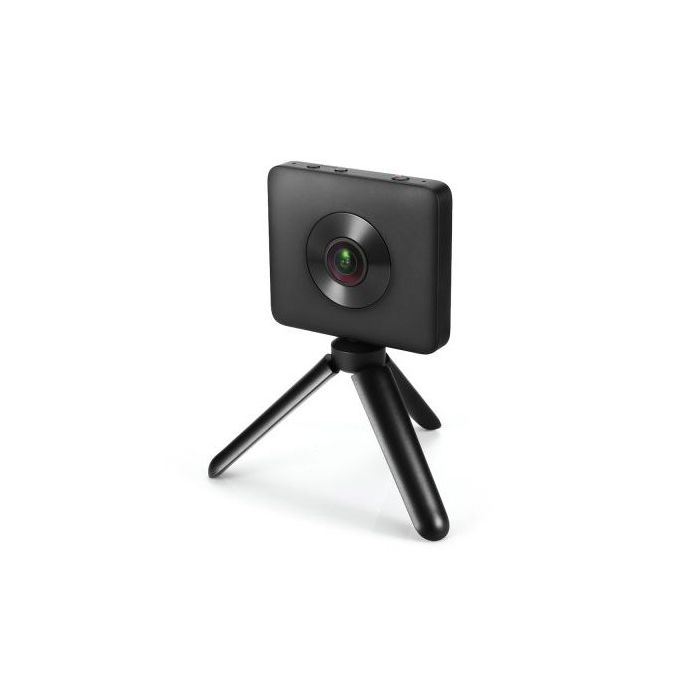
- A spherical camera. A device with two lenses that builds the sphere on its own. Facebook recognises a number of models by name, among them the Ricoh Theta S, Samsung Gear 360, LG 360 Cam, Giroptic 360 Cam, IC Realtech ALLie, 360Fly and Panono. That list has not changed in years, and that matters for the third method described below.
- A DSLR on a panoramic head. A dozen or so frames stitched in software, PTGui for example. The most work and the best result, because you control focus and light in every direction.
With the last two routes the metadata usually dies in post-processing, and that is when you need one of the methods below.
What photo metadata is
Metadata is text information stored inside an image file, next to the picture itself. It usually holds the camera model, the date and time of the shot, sometimes the location. For Facebook one specific field matters: the note that the photo is spherical.
The standard used by Facebook and Google Maps was defined by Google under the name Photo Sphere. The field is called ProjectionType, and the only value those services support is equirectangular, which means spherical projection. This is the same piece of information the tools below write, except they do it for you.
Injecting metadata into photos
For Facebook to recognise the panorama, you only need to meet one of two conditions:
- set a projection type that says the photo is spherical
- write in the make and model of one of the supported spherical cameras
Projection types
Panoramic photography uses several projection types, depending on how the photo was taken and how it is meant to be shown. Metadata uses the English names. On Facebook you will meet two of them:
- equirectangular – the spherical panorama this article is about
- cylindrical – a cylindrical panorama, those wide strips from your phone’s panorama mode

Spherical cameras recognised by name
Even a photo shot with a spherical camera can lose its metadata in post-processing. You can then restore it, or take a shortcut and write into the file the name of one of the cameras Facebook knows. The same trick rescues panoramas stitched from DSLR frames, because stitching software does not always write the full set of information.
The cameras Facebook uses to identify a spherical photo:
- Ricoh Theta S – see it on Ceneo.
- Giroptic 360 Cam
- Samsung Gear 360
- LG 360 Cam
- IC Realtech ALLie
- 360Fly
- Panono
Several of these models are no longer sold new, and the list still works. Facebook checks the name written in the file, not whether the camera is on the market. That is why typing in Ricoh Theta S is still the most reliable trick when nothing else helps.
Method 1. Adding metadata in your browser
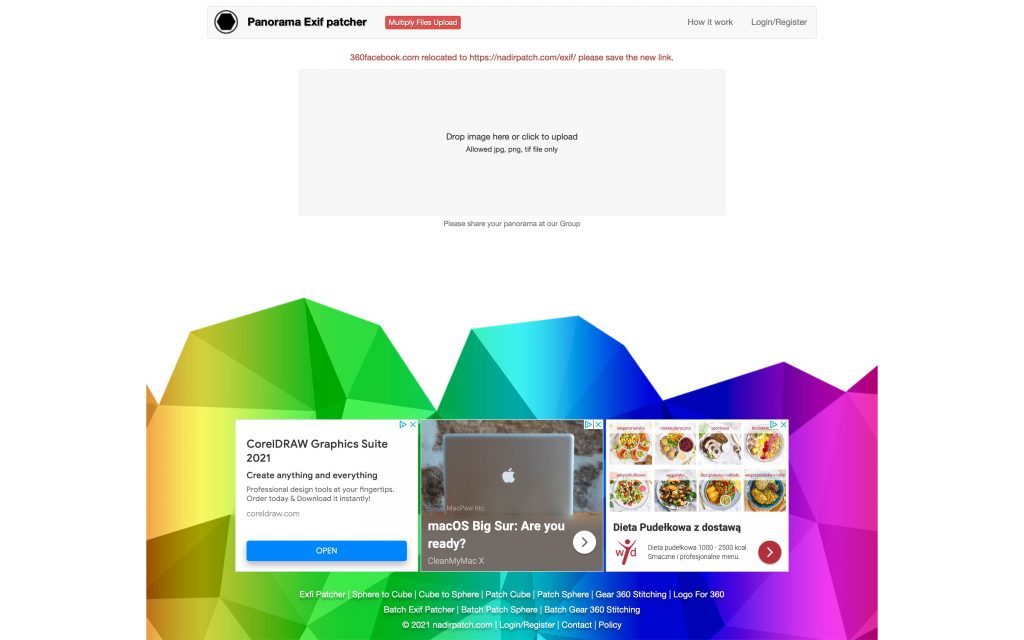
For a single photo the fastest option is Panorama Exif Patcher, which runs in the browser with nothing to install. You will find it at nadirpatch.com/exif.
1. Open the Panorama Exif Patcher page
2. Add the photo
Add the photo by clicking the white box or by dragging the file onto it.
3. Download the fixed file
After a moment the finished photo downloads to your disk on its own. That is the file you upload to Facebook, not the original.

When you have more photos
Sometimes the photo you add does not have the right proportions. It is worth checking at which stage it lost them and coming back with a correct file, instead of working around the problem.
The site can also process many photos at once, but that is a paid service, from five dollars per hundred files. With a larger batch of panoramas a desktop app, described below, works out cheaper.

Method 2. Exif Fixer on your computer
With a larger batch of panoramas a desktop app is more convenient. I reach for Exif Fixer, available on macOS, Windows and Linux. There is also a version that runs in the browser.
What Exif Fixer can do
It is a simple app for repairing panoramas. It lets you write several pieces of information into the file at once:

- the projection type, equirectangular or cylindrical
- the name of one of the spherical cameras
- which way north points in the panorama
- processing many files at once, using the settings of the first one
Three steps to use it
In most situations three steps are enough.
1. Add the photos
Drag a single file into the app window. The Choose JPEG or PNG button works too, but the dialogs that follow will show up in German.

With many photos, drag them all in and tick the Batch option so that each one gets the same settings.
2. Save the file
Click Add Metadata and you are done. If you want to keep the original, untick Delete Original Image first.
3. Pose as a camera when you have to
When the projection type alone is not enough, use the Insert Fake Camera Data option and pick, for example, Ricoh Theta S. This is the same mechanism I wrote about above: what counts is the name stored in the file.
Method 3. Photos Exif Editor
The third app gives you the most freedom when editing metadata. You can get Photos Exif Editor from the App Store. Beyond panoramas it comes in handy when you want to add the location of a shot by pointing at it on a map.
One limitation: this app will not set the projection type. That leaves the camera name route, and in practice it is enough.
1. Add the photo
Drag the file onto the app window or choose Add Photos/Folders. You can also point it at a whole photo library.

The left column holds the photos you added, the right one the fields you can edit.
2. Enter the camera model
In this example the file is going to pose as a shot from a Ricoh Theta S. Find the Camera section and fill in two fields:
- Make: Ricoh
- Camera model name: Ricoh Theta S

3. Save the photos
Click the green Start Process button and pick where to save. Save to a separate folder, not over the originals. Overwriting files in place can fail, and then it is easier to lose the material than to get it back.
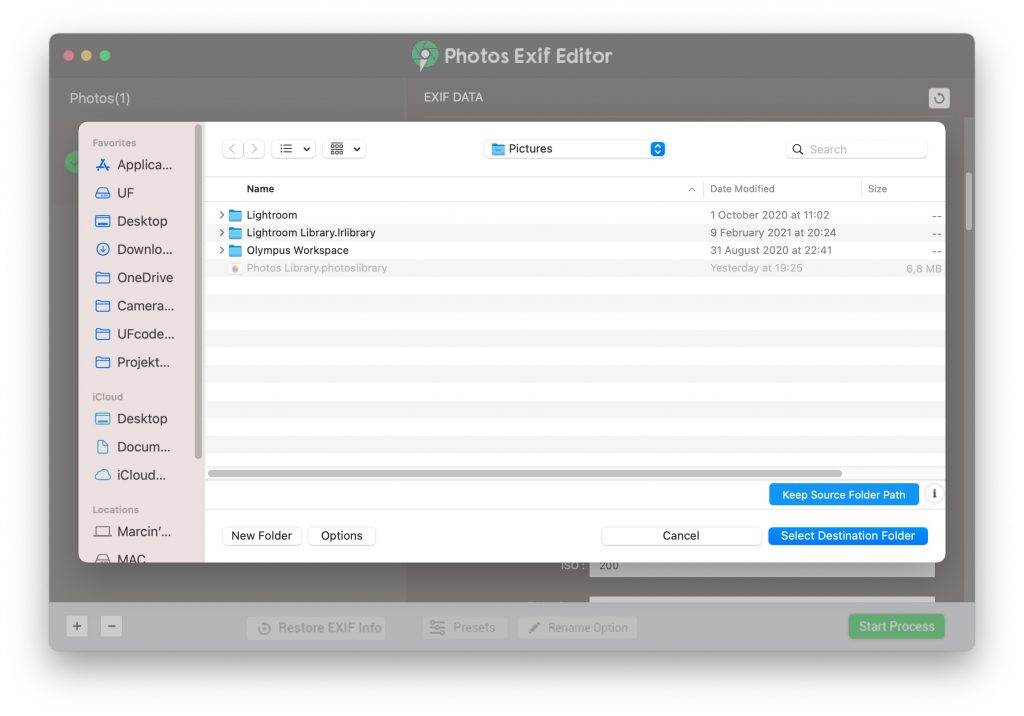
Settings saved for the next photos
If the panorama now displays the way you want, save these settings as a ready-made preset. Next time you can pick it from a list instead of filling in the fields again.
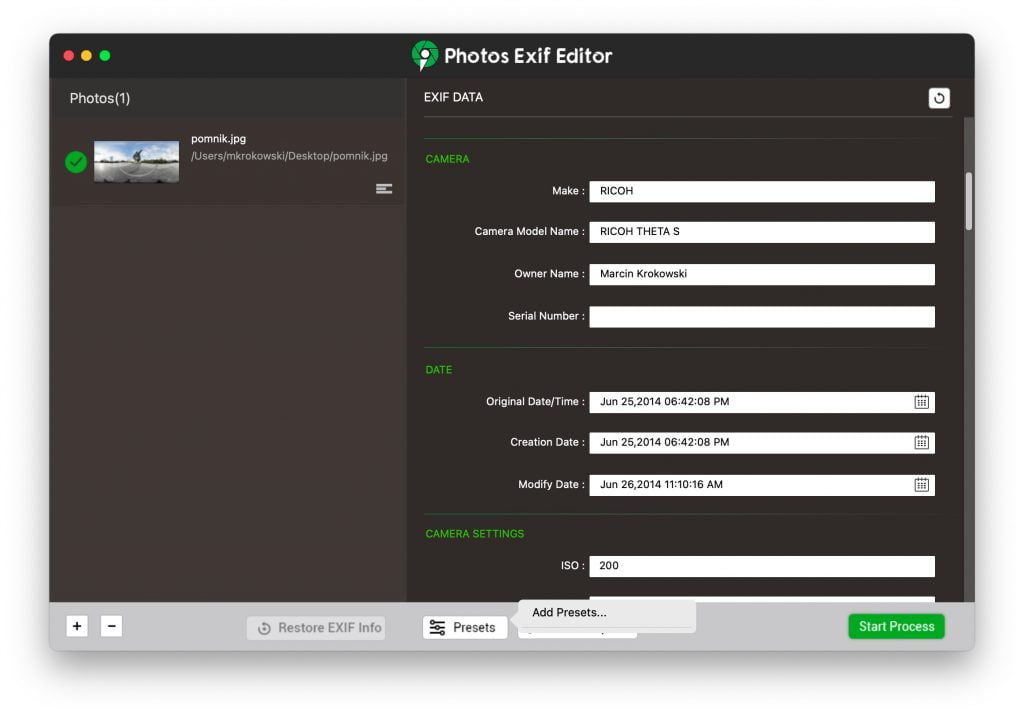
- In the main window click Presets > Edit Presets
- In the new window, in the bottom left corner, click +
- Give the preset a name
- Fill in the Make and Camera Model Name fields as before
- Click Apply

Instagram will not play a photo like this
This question comes back every time someone publishes their first panorama on Facebook. Instagram has no spherical view. The same file that turns in every direction on Facebook will be cropped to a square or a vertical frame on Instagram, and it loses the point.
If you care about both services, prepare two things from the panorama: the full spherical file for Facebook and separate, ordinary frames cut out of the panorama for Instagram. A crop from a panorama looks like a normal photo and needs no metadata at all.
When one photo is not enough
You can shoot and fix a single 360 photo yourself, in fifteen minutes. A whole venue is a different job: the panoramas have to be joined into a route that takes the client from the entrance through every room, with captions and a floor plan. A virtual tour like that also works in your Google Business Profile, not just on Facebook.
If you want to embed such a tour on your own site, I covered that separately in the guide on adding a virtual tour to a WordPress site.
I shoot 360 tours in Warsaw and the surrounding area, for clinics, showrooms, hotels and rental venues.